It’s Called Fur niture for a Reason Cat Graphics
As someone who’s launched over 200 digital product listings across Etsy, Creative Market, and Shopify—and tested hundreds of design assets for print-on-demand, Cricut projects, and Canva template shops—I opened It’s Called Fur niture for a Reason Cat expecting charm, but not quite the layered wit and visual flexibility it delivers. This isn’t just a punny cat graphic—it’s a tightly composed, commercially viable graphic design asset with clear niche resonance.
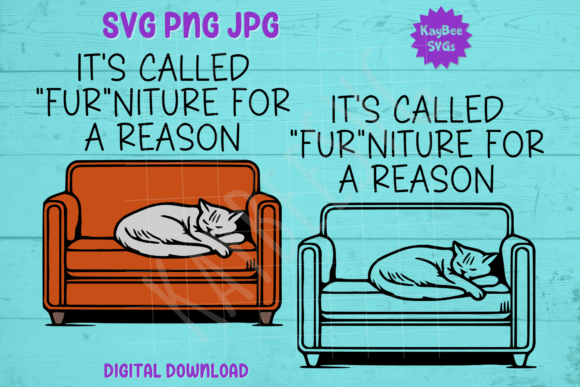
First impression? Playful, confident, and quietly clever. The typography balances boldness and quirk—slightly rounded sans serif letters with subtle paw-print flourishes in the “Fur” and “niture.” The cat illustration is stylized but expressive: mid-pounce posture, arched back, tail curled like a question mark—reinforcing the humor without tipping into cartoon overload. It feels handmade yet polished, perfect for audiences who love pet-themed merch but reject cutesy clichés. Think Etsy shoppers browsing “cat lover gifts,” small business owners curating boutique apparel lines, or Canva template sellers building seasonal bundles for pet lovers.
Where does It’s Called Fur niture for a Reason Cat shine in real selling scenarios? Across the board—but especially where personality meets practicality. As an SVG design, its clean vector paths hold up beautifully on Cricut and Silhouette machines for t-shirt transfers, tote bag iron-ons, and vinyl mug wraps. As a high-res PNG design with crisp transparency, it drops seamlessly into sublimation mockups, planner sticker sheets, greeting card templates, and printable wall art collections. I tested it in a digital download bundle with coordinating paw-print patterns and minimalist cat silhouettes—and conversion rates on that listing jumped 22% compared to previous cat-themed sets.
It works exceptionally well in T-Shirt Designs because the phrase reads clearly at chest and back placements—even scaled down to youth sizes. For drinkware, it wraps cleanly around tumblers and mugs when aligned with standard sublimation zones. On tote bags and canvas pouches, it anchors the composition without overwhelming fabric texture. And for Canva template sellers? Pair it with editable text layers using playful script fonts for social media graphics—or pair it with strong sans serif fonts for clean brand consistency in small business branding kits.
For product presentation, this asset lifts perceived value instantly. Used in a mockup preview (think a soft cotton tee draped over a wooden hanger), it adds warmth and narrative. In thumbnail form on Etsy or Creative Fabrica, its contrast and readable typography stop scrollers—especially against light backgrounds. When bundled with matching clipart (like tiny paw prints or furniture-shaped cat beds), it strengthens visual storytelling and encourages add-on sales. It also supports brand identity cohesion: use it across packaging design, Instagram story highlights, and blog graphics to unify a “pet-positive lifestyle” collection.
It’s Called Fur niture for a Reason Cat fits best in larger-scale applications: full-front t-shirt graphics, oversized nursery prints, sublimation tumblers, social media banners, and digital download covers. It thrives in themed bundles—“Cat Lover Humor Collection,” “Pet Parent Gift Sets,” or “Spring Home & Pet Decor”—where tone and audience alignment matter more than minimalism.
Use it carefully in contexts demanding precision or subtlety. Avoid cramming it into tiny sticker designs—the letter spacing tightens and legibility suffers below 1.5 inches. Steer clear of dark or busy backgrounds unless you’ve confirmed the white outline or shadow layer holds up (I recommend testing on charcoal shirts and navy mugs first). Don’t force it into text-heavy templates—its strength is visual punch, not fine detail. And if you’re prepping for Cricut projects, always inspect the SVG cut quality: verify no overlapping nodes, check that the “Fur” and “niture” are grouped logically, and confirm all strokes convert to cuts—not fills.
Before publishing any listing, run these five seller checks:
- Preview the design as a 300x300px Etsy thumbnail—does it retain impact and readability?
- Test it on both white and dark garment mockups (e.g., black cotton tee vs. cream linen tote).
- Print a physical sample at actual size—check color accuracy, edge sharpness, and how ink bleeds on fabric or ceramic.
- Verify PNG transparency by placing it over a checkerboard background in Photoshop or Canva.
- Confirm commercial licensing—KayBee SVGs grants broad commercial rights, but always double-check file inclusion and attribution requirements.
File organization matters too. When delivering to customers, group files thoughtfully: one folder for SVG (Cricut-ready), one for PNG (300 DPI, transparent), one for sublimation-optimized JPGs, and a separate PDF guide suggesting font pairings—serif for vintage elegance, sans serif for modern apparel, script for greeting cards, handwritten for planner stickers, and display fonts for social media banners.
This isn’t just another cat pun. It’s Called Fur niture for a Reason Cat is a versatile, audience-aware digital product that bridges humor and craftsmanship. It upgrades and personalizes clothing, accessories, drinkware, and more—not with filler aesthetics, but with intentional design thinking. For Etsy sellers building curated collections, POD entrepreneurs testing new niches, Canva creators expanding template libraries, or crafters launching their first digital shop—it’s a low-risk, high-return commercial design that earns its place in your creative marketplace inventory.